 Contact Information
meyer@umbc.edu
410-455-2534
Physics, Rm 312
Title
Professor
Previous Positions
Associate Professor, UMBC, 2021 – 2025
Assistant Professor, UMBC, 2015 – 2021
Postdoctoral Fellow, Space Telescope Science Institute (STScI), 2012 – 2015
Education
Ph.D. Physics – Rice University (Houston, TX), 2012
M.S. Physics – Rice University (Houston, TX), 2008
B.S. Astrophysics – Rice University (Houston, TX), 2005
Professional Interests
How did galaxies first form, and how have they changed over billions of years to produce the Universe we see today? This is one of the biggest questions in astronomy. We now know that most — probably all — massive galaxies have a supermassive black hole at their center. As an observational astronomer, Dr. Meyer studies how these growing black holes shape the galaxies and space around them.
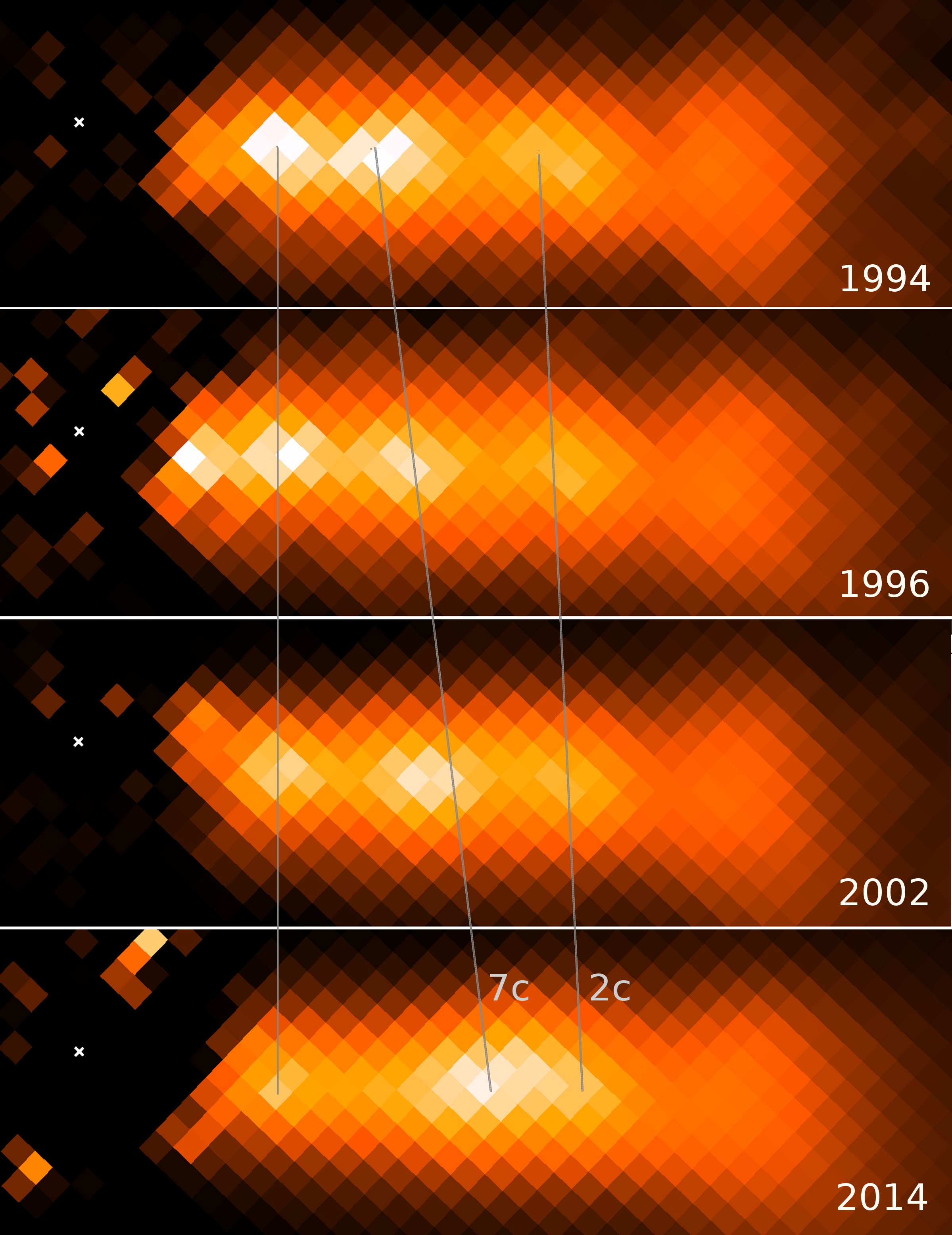
She is especially interested in relativistic jets — narrow beams of matter that supermassive black holes shoot out at nearly the speed of light. These jets almost certainly have a major effect on their home galaxies and galaxy clusters over time, though many questions remain about how they work.
Dr. Meyer’s group uses observations across the full electromagnetic spectrum, from radio waves to very high-energy gamma-rays. She has been awarded over 400 hours of observing time on flagship facilities, including the Very Large Array, the Atacama Large Millimeter/submillimeter Array (ALMA), the Very Large Telescope (VLT), the Hubble Space Telescope, NASA’s Chandra X-ray Observatory, and NASA’s Fermi Gamma-ray Space Telescope. The Meyer/Georganopoulos research group has received more than $1.7 million in recent funding from NASA and the National Science Foundation ($3.4 million lifetime total), and regularly collaborates with scientists at NASA, the Space Telescope Science Institute, and universities around the world. Current students are working on projects that range from tracking the motion of material inside jets, to studying how the X-ray brightness of jets changes over time in order to figure out how that X-ray light is produced.
Alongside her core work on black hole jets, Dr. Meyer develops new optical polarimetry instruments — specialized cameras that measure polarization, a subtle property of light that can reveal information about what produced or reflected it. These instruments are built for small ground-based telescopes, including the 32-inch telescope at the UMBC Observatory. Working with UMBC adjunct professor Bill Sparks (primary affiliation SETI Institute) and collaborators around the world, the UMBC group has built several prototypes aimed at measuring polarization at extraordinary sensitivity — at the level of one part in a million. Students from physics or engineering who are interested in this work are encouraged to reach out about opportunities in the Astronomical Polarimetry (AstroPol) Lab.
Selected Publications