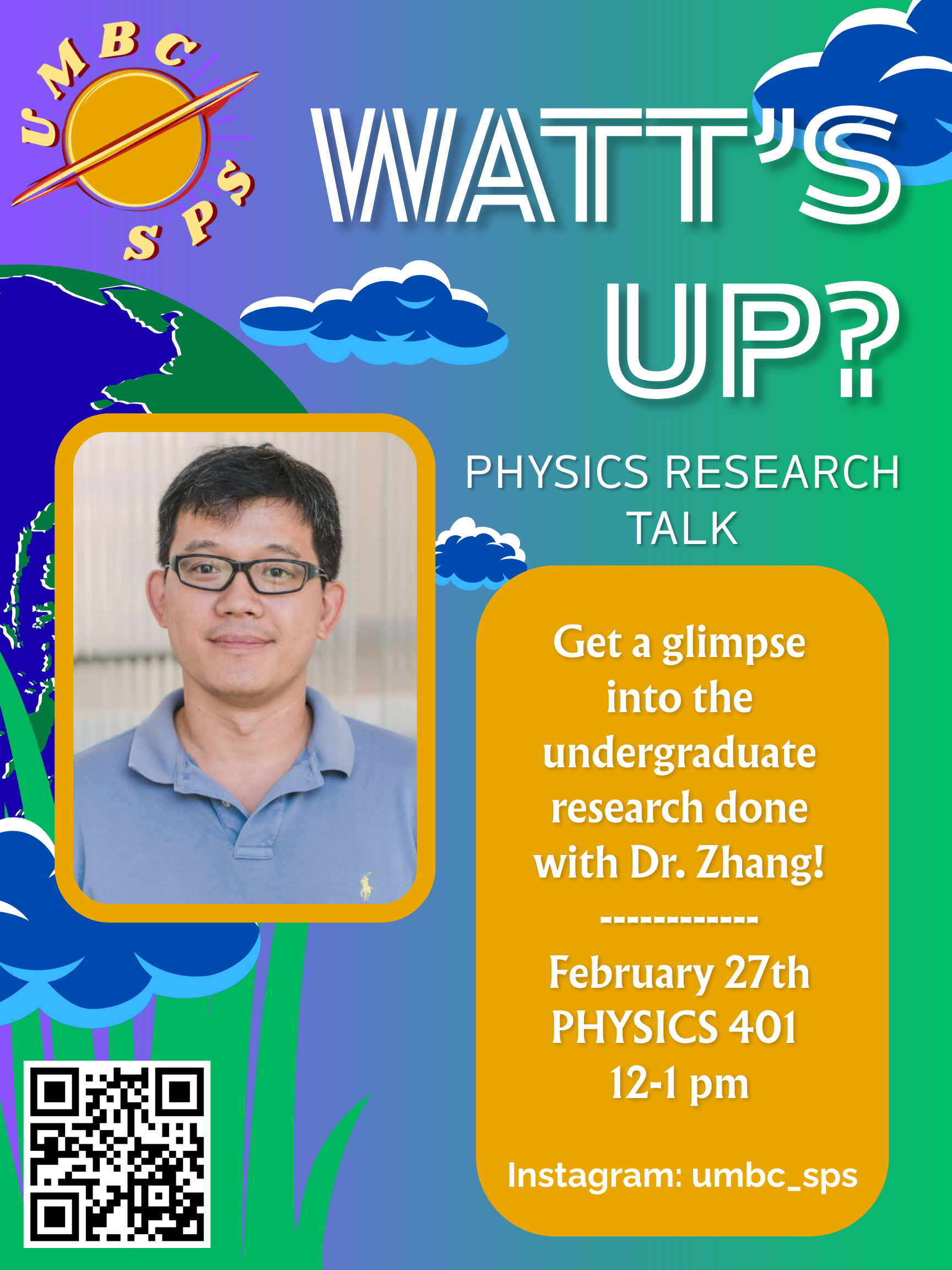
UMBC SPS: Watt’s Up with Dr. Zhang
In-Person PHYS 201
Location
Physics : 401
Date & Time
February 27, 2026, 12:00 pm – 1:00 pm
Description
Aerosols—such as sulfate, smoke, and dust—are tiny particles suspended in the atmosphere. Cloud particles consist of water droplets in liquid-phase clouds and ice crystals in ice-phase clouds. Although aerosol and cloud particles are often invisible or barely detectable to the human eye, their impacts on climate, weather, health, and ecosystems are profound. These particles significantly influence Earth's climate by modulating both the radiation budget and the hydrological cycle. Aerosols directly scatter and absorb sunlight, producing cooling or warming effects depending on their composition, optical properties, and the underlying surface brightness. They also influence climate indirectly by serving as cloud condensation nuclei (CCN) and ice-nucleating particles (INPs), thereby altering cloud reflectivity, lifetime, and precipitation efficiency. Clouds themselves play a vital role in Earth’s energy balance by reflecting incoming solar radiation (a cooling effect) and trapping outgoing terrestrial radiation (a warming effect).
Because of the complex and highly variable nature of these processes, accurately quantifying the net climate impacts of aerosols and clouds remains one of the greatest challenges in climate science. Remote sensing—through satellite and ground-based observations—has become an indispensable tool for studying the effects of aerosols and clouds on climate across regional to global scales.
In this talk, I will begin with an overview of the fundamental climate effects of aerosol and cloud particles and then highlight recent research from our ACROS group on aerosol and cloud remote sensing. I will conclude by briefly discussing current challenges in this field and how collaborations between physicists and mathematicians could help drive future breakthroughs.
